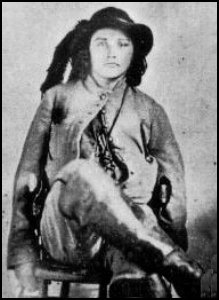
 The life and death of Marcellus Jerome Clarke (August 25, 1844 – March 15, 1865)—better known as "Sue Mundy"—is one of the most complex intersections of Civil War history,
media sensationalism, and gender performance in 19th-century Kentucky.
The life and death of Marcellus Jerome Clarke (August 25, 1844 – March 15, 1865)—better known as "Sue Mundy"—is one of the most complex intersections of Civil War history,
media sensationalism, and gender performance in 19th-century Kentucky.Queer Places:
Greenlawn and Shady Rest Cemetery, 420 Cemetery Street, Franklin, Kentucky 42135 United States
The life and death of Marcellus Jerome Clarke (August 25, 1844 – March 15, 1865)—better known as "Sue Mundy"—is one of the most complex intersections of Civil War history,
media sensationalism, and gender performance in 19th-century Kentucky.
Born in Franklin, Simpson County, in 1844, Marcellus Jerome Clarke was a Confederate soldier who evolved into a guerrilla leader during the final year of the Civil War.
Clarke enlisted at 17, served in the 4th Kentucky Infantry, and later rode with the famous cavalry commander John Hunt Morgan.
After Morgan’s death in 1864, Clarke formed his own guerrilla band. These groups operated in a period of social collapse, often engaging in raids, theft, and violence against both Union and Confederate sympathizers.
Clarke was captured on March 12, 1865, in Meade County, Kentucky. He was tried and hanged in Louisville just three days later, on March 15, 1865, at the age of 20.
The moniker "Sue Mundy" was not a name Clarke initially claimed, but rather a persona manufactured by the media—specifically George Prentice, the influential editor of the Louisville Journal.
Prentice created the "Sue Mundy" character to mock the Union’s inability to maintain order, portraying the guerrilla as a female "she-devil" to maximize the embarrassment of Union military officials.
The name stuck to Clarke in part due to his physical appearance: he was known for his "almost feminine beauty," smooth-shaven face, and long, flowing hair. These features, combined with his youth, allowed the press to easily project this gender-bending identity onto him.
Interestingly, other guerrillas, such as Henry C. Magruder, also claimed to be the "original" Sue Mundy, suggesting that the name functioned as a collective, frightening brand rather than a singular identity tied to one person.
In the context of Kentucky’s LGBTQ history, Clarke’s story is often cited as a prime example of the difficulty in interpreting the past through modern lenses.
Because nineteenth-century records rarely used explicit terminology for sexual or gender identity, historians look to figures like Clarke to identify "queer" or gender-nonconforming experiences.
Whether Clarke consciously used the "Sue Mundy" persona to subvert gender norms or whether the media forced it upon him remains a subject of historical debate. Some scholars suggest that his choice to maintain his long hair and "boyish" appearance in the rugged, violent environment of guerrilla warfare may have been a deliberate form of self-presentation that challenged the era's hyper-masculine military expectations.
While there is no definitive documentation confirming how Clarke personally identified, his inclusion in LGBTQ historical narratives highlights the ways that Civil War-era gender nonconformity—whether imposed by the press or adopted by the individual—often occupied a liminal, highly scrutinized space in the public imagination.
References:
Support this project
This website is a passion project researched, developed, and funded entirely by me. If you find the content valuable and would like to help support the ongoing research and hosting costs, any contribution is deeply appreciated.
Thank you for keeping this independent resource alive!
My books on Amazon: Elisa Rolle's books